Cold Email Follow-Up Sequence: Timing, Count and Templates
How many cold email follow-ups to send and when: 4 follow-ups on days 2, 5, 10 and 15, threading, stop rules, short templates and the mailboxes you need.

On this page
A cold email follow-up sequence that works for most offers is the first email plus 4 follow-ups, sent on days 0, 2, 5, 10 and 15. The gaps between emails are 2, 3, 5 and 5 days: short while the first email is still recent, longer later. Send each follow-up as a plain-text reply in the same thread, give it one new point, and stop the sequence for a contact the moment they reply, bounce or ask to be removed.
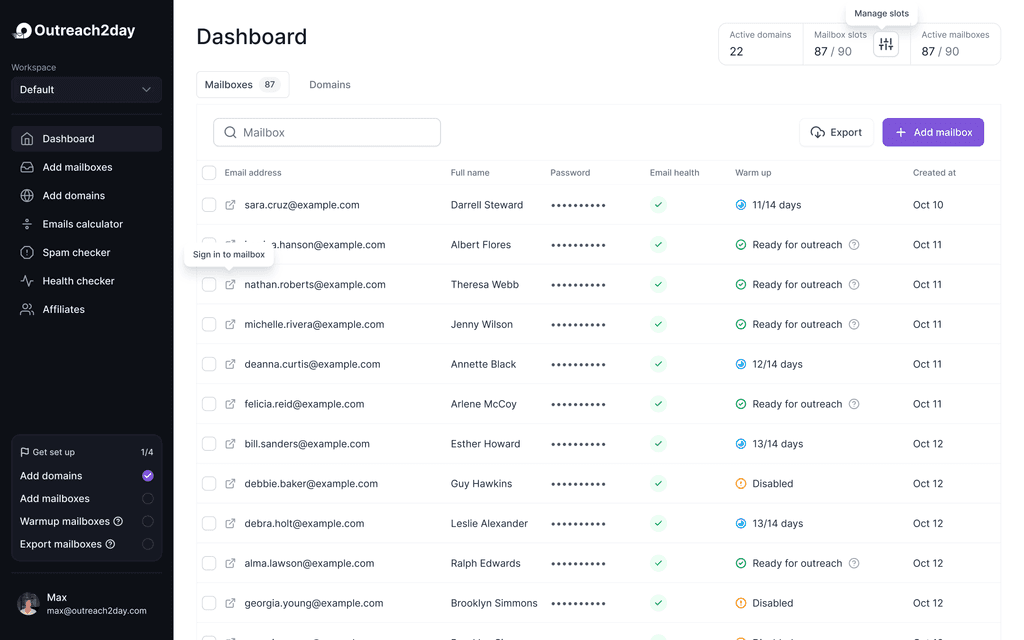
We make Outreach2day, cold email infrastructure. Our sending engine runs campaigns and sequences, and it is included in the $2.50 per mailbox per month. The rules below are the ones we recommend to our users, whatever tool sends the emails.
The Sequence: 5 Emails Over 15 Days
Step | Day | Gap after previous email | Job of the step |
|---|---|---|---|
First email | 0 | None | State the offer and ask one yes-or-no fit question |
Follow-up 1 | 2 | 2 days | Add the one detail the first email left out: how it works, or the terms |
Follow-up 2 | 5 | 3 days | Give proof: a specific result or a short example from a similar company |
Follow-up 3 | 10 | 5 days | Take a different angle: another problem you solve, or a smaller first step |
Follow-up 4 | 15 | 5 days | Close the loop: a direct yes-or-no question, then stop |
After day 15 the contact leaves the sequence. Don't move them into another campaign for the same offer.
How to Enter the Gaps in a Sequencer
Tools store the gap in one of two ways. Some put the wait on the step it delays (enter 0, 2, 3, 5, 5 days on steps 1 to 5). Others ask "send the next message in N days" on the previous step (enter 2, 3, 5, 5 on steps 1 to 4 and nothing on step 5). If you don't know which one your tool uses, check its schedule preview on 2 or 3 test contacts before launch; a wrong mapping sends two steps on the same day. The follow-up sequence planner skill does this mapping for you and drafts each step.
If your tool skips weekends, the gaps count sending days, and the calendar length of the sequence grows by the weekends in between.
Why the Spacing Widens
The first follow-up comes soon. Two days after the first email, the reader may still remember it, and a short reply in the same thread brings it back to the top of the inbox.
Later follow-ups need more room. Someone who didn't answer two or three emails is either busy or not interested. Writing every two days to that person reads as pressure and invites a spam report instead of a reply.
The sequence has an end. Four follow-ups over 15 days gives each contact five chances to see a relevant message. More steps add sends, and each send uses mailbox capacity and adds complaint risk, while the contact has already seen the offer several times.
Same Thread or New Thread?
Send follow-ups 1 to 4 as replies in the same thread: leave the subject empty or identical in your tool so it goes out as "Re:" on the original subject, with the earlier email quoted below. The reader sees the context without opening anything else.
Keep the thread honest. Google's sender guidelines say not to "send messages with subject lines starting with Re: or Fwd: unless the messages are actual replies or forwards." A follow-up in its own thread is an actual reply. A first email with a fake "Re:" in the subject is not.
Start a new thread only for a separate campaign weeks later, with a new reason to write and a new subject.
Keep every step plain text: no images, no tracking pixel, no links. Links and open tracking add spam risk and tell you little; see open tracking, links and deliverability.
When to Stop the Sequence
Stop for a contact, in every campaign and every mailbox, when any of these happens:
Event | Action |
|---|---|
Any human reply, including "not interested" | Stop. Answer it by hand |
Opt-out request, in any wording | Stop and add the address to a shared do-not-contact list |
Hard bounce | Stop and remove the address from all lists |
Out-of-office reply | Pause and resume after the return date if your tool supports it; otherwise stop |
Other auto-reply (left the company, ticket received) | Stop. If it names a new contact, start that person as a new contact |
A colleague at the same company replies | Stop for everyone at that company if your tool supports it |
Auto-replies are not always easy to detect. RFC 3834 says an automatic response "SHOULD" carry the header Auto-Submitted: auto-replied, which is a recommendation, not a requirement, so tools also look at the reply text. Check your tool's reply classification on the first replies of a new campaign.
Follow-Up Templates
Short, plain text, one point per email, and no links, URLs or domain names anywhere, including the signature. Replace the square brackets with your own merge fields. Each email ends with an opt-out line, and the last one says it is the last. If CAN-SPAM applies to you, add your postal address to the signature as plain text (see the legal section below).
First email (day 0)
Subject: [First name], question about [problem]

Hi [First name],

We help [type of company] [do the specific thing] without [the usual cost or hassle]. For a team your size that usually means [concrete outcome].

Is this something [Company] is dealing with right now?

[Your name]
[Title], [Your company]

If this isn't relevant, reply "no" and I won't write again.
Follow-up 1 (day 2): how it works
Subject: empty, sent as a reply in the same thread

Hi [First name],

One detail I left out: [how it works in one or two sentences, or the terms: price, contract, time to start].

Worth a short call to see if it fits?

[Your name]

Not relevant? Reply "no" and I'll stop.
Follow-up 2 (day 5): proof
Subject: empty, same thread

Hi [First name],

[Similar company or role] had the same issue with [problem]. After [time], they [specific result with a number you can back up].

Happy to walk you through what they changed. Would that help?

[Your name]

If it's not a fit, a quick "no" is fine and I won't follow up.
Follow-up 3 (day 10): different angle
Subject: empty, same thread

Hi [First name],

If [problem from the first email] isn't a priority, maybe [second problem you solve] is. We can start with [small first step] and you judge from there.

Does that sound useful?

[Your name]

Reply "no" and I'll take you off my list.
Follow-up 4 (day 15): close the loop
Subject: empty, same thread

Hi [First name],

I haven't heard back, so I'll assume the timing is wrong and close this out. This is my last email about it. If [problem] comes up later, just reply here.

[Your name]
Before you launch, paste each step into the cold email copy checker for length, links and spam-trigger words. If you vary the wording with spintax, run it through the spintax validator so a broken brace doesn't go out to prospects. For first-email frameworks, see 8 cold email templates.
How Many Mailboxes a Sequence Needs
Follow-ups are sends. They come out of the same budget as first emails: up to 25 cold emails per mailbox per day, not counting warm-up (see cold emails per mailbox per day).
Say you add 100 new prospects a day. Each prospect gets up to 5 emails, one on each of days 0, 2, 5, 10 and 15. The daily sends build up as the steps overlap:
Campaign day | Steps sending that day | Sends per day |
|---|---|---|
0 to 1 | First email | 100 |
2 to 4 | First email, follow-up 1 | 200 |
5 to 9 | First email, follow-ups 1 and 2 | 300 |
10 to 14 | First email, follow-ups 1 to 3 | 400 |
15 onward | All 5 steps | 500 |
At steady state: 100 prospects × 5 steps = 500 sends a day. At 25 per mailbox, that is 500 ÷ 25 = 20 mailboxes, and at up to 5 mailboxes per domain, 20 ÷ 5 = 4 domains. On Outreach2day, 20 mailboxes cost 20 × $2.50 = $50 a month, plus 4 .com domains at $13 a year each (and a card processing fee on domain purchases). Replies, bounces and opt-outs remove contacts before later steps, so real volume ends up somewhat below 500; size for 500 anyway.
The same arithmetic backwards: mailboxes × 25 ÷ 5 = new prospects a day. With 12 mailboxes, that is 12 × 25 ÷ 5 = 60 new prospects a day. The cold email capacity calculator runs these numbers for other volumes. New mailboxes need their own warm-up before they send; see the email warm-up schedule.
The Opt-Out Line and the Legal Basics
Every step above ends with a way out. That keeps complaints down, and in the United States it is a legal requirement for commercial email.
The FTC's CAN-SPAM compliance guide says:
The law covers "all commercial messages" and "makes no exception for business-to-business email."
Your message "must include a clear and conspicuous explanation of how the recipient can opt out of getting marketing email from you in the future," using "a return email address or another easy Internet-based way."
The opt-out must be able to process requests "for at least 30 days after you send your message," and you "must honor a recipient's opt-out request within 10 business days."
The message must include "your valid physical postal address," must not use false or misleading header information or deceptive subject lines, and must be identified as an advertisement.
"Each separate email in violation of the CAN-SPAM Act is subject to penalties of up to $53,088."
A reply-based opt-out ("reply no and I won't write again") uses the return email address, which the FTC names as an accepted method. In practice: put your postal address in the signature as plain text, honor every opt-out across all campaigns and mailboxes, and keep a single do-not-contact list. Other countries have their own rules; check the ones that apply to your recipients with counsel. For the separate Gmail and Yahoo rules on one-click unsubscribe headers, see one-click unsubscribe for cold email.
FAQ
How many follow-ups should I send after a cold email?
Four follow-ups after the first email, on days 2, 5, 10 and 15. More steps add sends and complaint risk to contacts who have already seen the offer several times.
How long should I wait before following up on a cold email?
Two days for the first follow-up, then 3, 5 and 5 days between the next ones. If your tool counts only weekdays, the same gaps span a longer calendar period.
What should I write in a follow-up after no response?
One new point per email: how it works, a proof point, a different angle, then a direct yes-or-no close. Avoid follow-ups that only say you are checking in.
Should cold email follow-ups have a new subject line?
No. Send them as replies in the same thread so the reader sees the first email below. Use a new subject only for a separate campaign weeks later.
Do follow-ups count toward the daily sending limit?
Yes. Every step is a send from the mailbox, so follow-ups share the 25 cold emails per mailbox per day with first emails.
Sources
Checked September 2026:
Google: Email sender guidelines: don't use subject lines starting with "Re:" or "Fwd:" unless the messages are actual replies or forwards.
RFC 3834: Recommendations for Automatic Responses to Electronic Mail: automatic responses SHOULD include the header "Auto-Submitted: auto-replied".
FTC: CAN-SPAM Act compliance guide for business: coverage of all commercial email with no B2B exception, the opt-out explanation and methods, 30-day and 10-business-day opt-out rules, postal address, header, subject line and ad identification requirements, penalties of up to $53,088 per email.
Build the sequence, then send it from mailboxes with warm-up, authentication and a shared reply inbox included.
Keep reading
Send 100,000 cold emails a month
How to send 100,000 cold emails a month while keeping quality, engagement and conversion rates high: domains, mailboxes, warm-up, leads, copy and scaling.
Step-by-step playbook · 19 min readCold email10 min read
8 Cold Email Templates and When to Use Them
Cold email5 min read
15 ChatGPT Prompts for Cold Email Operations
Cold email6 min read
15 Claude Code Prompts for Cold Email