
Cold email deliverability answers
Direct answers to the questions we get most about inbox placement, bounces, warm-up and domains. Each page starts with the short answer, then the checks and the steps, with the provider documentation it relies on.
Gmail and Google
What Does Gmail's 421 4.7.28 Error Mean, and How Do I Fix It?
421 4.7.28 is a temporary deferral: Gmail saw an unusual rate of email, often unsolicited, from your IP address, IP block, DKIM or SPF domain, or a URL domain in your messages, and slowed it down. Stop sending for at least 10 minutes, find which quota the text names, resume on a single connection, and lower your volume so it doesn't come back.
Should I Send Cold Email to Personal Gmail Addresses?
For B2B cold email, avoid personal Gmail addresses or send to them separately. Google's sender requirements and spam-rate limits are written for mail to personal Gmail accounts, these addresses are hard to verify, and cold email to private individuals carries more legal risk. If your audience mostly uses personal addresses, run them as a separate campaign with its own copy, volume and measurement.
Why Are My Cold Emails Going to Spam in Gmail in 2026?
Gmail puts cold email in spam when the sending IPs or domain have a low reputation, when authentication or DNS fails its sender requirements, when volume jumps, or when the text reads like mass mail. Split results by recipient provider, read the bounce codes, check SPF, DKIM, DMARC and PTR, then run a placement test with a neutral control email before you change anything.
What Replaces the Reputation Dashboards in Google Postmaster Tools?
Google says the Domain and IP Reputation dashboards will be retired and are not part of Postmaster Tools v2 or the v2 API. Use the Compliance status dashboard for sender requirements, the Spam rate dashboard for user complaints, and the Delivery errors dashboard, whose reasons include low IP reputation and low domain reputation. All of it covers mail to personal Gmail accounts only.
Outlook and Microsoft
Why Is Outlook Blocking or Junking My Cold Emails?
Outlook junks or rejects cold email for three main reasons: authentication that fails Microsoft's rules (bounce 550 5.7.515), a sending IP on Microsoft's blocklist (5.7.1, 5.7.511 or 5.7.606 to 649), or content and volume its filters distrust. Read the bounce code first. Fix SPF, DKIM and DMARC, request delisting if the IP is banned, then test the copy against a neutral email.
Bounces and errors
What Does a 550 5.7.1 Bounce Mean, and How Do I Fix It?
550 5.7.1 is a permanent rejection: the receiving server refused the message for a policy reason. The text after the code says which one. At Gmail it usually means low IP or domain reputation, unsolicited mail or a malformed message. At Microsoft 365 it usually means a blocklisted IP or a recipient-side restriction. Read the full bounce text, fix that cause, and don't retry the same message.
Why Is My Cold Email Bounce Rate So High?
A high bounce rate usually means the list has old or unverified addresses. Read the bounce texts: 'account does not exist' is a bad address, while reputation or policy texts are blocks and need a different fix. Stop the campaign, verify and clean the list, remove every hard-bounced address everywhere, and don't retry permanent failures. Check whether the bounces come from cold email or from warm-up.
What Spam Complaint Rate Is Too High for Cold Email?
Google asks senders to keep the spam rate reported in Postmaster Tools below 0.1% and never let it reach 0.3%. Yahoo's limit is also 0.3%. Both count complaints against mail delivered to the inbox, so the rate can look low while much of your mail sits in spam. For cold email, aim for as close to zero as you can and give recipients an easy way to opt out.
Warm-up
How Long Should I Warm Up a New Mailbox Before Cold Email?
Warm up a new mailbox for at least 14 days before it sends any cold email. From day 14, start cold email at a low volume and raise it gradually to full volume around day 21. Cheaper domains such as .info can need a couple of extra weeks. Keep warm-up running after you start sending.
Are Inbox Placement Tests Reliable for Cold Email?
A single placement test is not reliable: results for the same email can swing widely between runs, domains and times of day. Tests become useful when you compare inside one run. Send a neutral control email and your campaign email from the same mailboxes in the same minute, use several domains, count only completed tests, and repeat on another day before you act.
Should I Keep Warm-Up Running While Sending Cold Email?
Yes. Keep warm-up running for as long as the mailbox sends cold email. It keeps a steady flow of emails that are opened and replied to alongside your cold volume, and its inbox and spam rate warn you early when a mailbox or domain starts to slip. Keep warm-up volume steady and change it in small steps, never in jumps.
My Warm-Up Inbox Rate Dropped. What Does It Mean?
A drop in warm-up inbox rate is an early warning that providers trust the mailbox, its domain or its sending IPs less. It is not a measure of where your cold emails land. Check that warm-up is actually running, see which providers dropped and whether one domain or all of them did, look at recent volume changes, and hold cold volume until a placement test confirms the cause.
Volume and setup
How Many Cold Emails Should One Mailbox Send per Day?
Send up to 25 cold emails per mailbox a day, not counting warm-up. Above that, mailboxes and domains burn out sooner. Start new mailboxes at a low volume after at least 14 days of warm-up and reach 25 around day 21. To send more, add warmed mailboxes and domains instead of raising the per-mailbox number.
How Many Mailboxes Do I Need to Send N Cold Emails a Day?
Divide your daily cold email target by 25 to get the number of mailboxes, then divide by 5 to get the number of domains. For 1,000 cold emails a day you need 40 mailboxes on 8 domains. Add a few spare domains for replacements, and create everything at least three weeks before you need full volume, because new mailboxes need warm-up.
Does Cold Email Need a One-Click Unsubscribe Link?
Gmail and Yahoo require one-click unsubscribe headers (RFC 8058) on marketing and subscribed messages from bulk senders. Google counts a bulk sender as close to 5,000 or more messages a day to personal Gmail accounts from one primary domain. Whether that covers your cold email depends on volume and audience. Either way, give every recipient an easy opt-out and honor it within 48 hours.
Do Open Tracking and Links Hurt Cold Email Deliverability?
They add risk and tell you little. Google names links as content that makes spam classification more likely, can rate-limit mail by the URL domains it contains, and says low open rates are not an accurate sign of deliverability problems. In cold email, leave out tracking pixels, images and links in the first email, share links after someone replies, and measure replies instead of opens.
Do I Need SPF, DKIM and DMARC for Cold Email?
Yes. Set up SPF, DKIM and DMARC on every domain you send cold email from. Gmail and Yahoo require SPF or DKIM from all senders and all three from bulk senders, and Outlook.com rejects high-volume mail that fails them. A DMARC policy of p=none is enough, but the From: domain must align with SPF or DKIM. Authentication is the minimum, not a guarantee of the inbox.
Domains
My Cold Email Domain Is Burned. What Should I Do?
First confirm that the domain is what burned. Test a neutral email and your campaign email from the same mailboxes, and compare the domain with others on the same sending IPs. If only that domain fails, pause it, try a fresh campaign or list on it, and retire it if it doesn't recover. If the copy is the problem, new domains won't help: rewrite the copy.
Is .info or .com Better for Cold Email Domains?
Choose .com when you can. A .info domain costs less, but it can need a couple of extra weeks of warm-up, and in our tests with finance and lending copy .info did 3.5 times worse on Outlook than .co. With neutral copy we saw no difference. If you use .info, warm it up longer, keep the copy plain and check the renewal price before you buy.
How Many Mailboxes Should I Put on One Cold Email Domain?
Put up to 5 mailboxes on one cold email domain. Providers judge reputation per domain as well as per mailbox, so every mailbox on a domain shares its fate. At up to 25 cold emails per mailbox a day, 5 mailboxes means up to 125 cold emails a day from one domain. For more volume, add domains, not mailboxes per domain.
Can I Send Cold Email From My Main Company Domain?
No. Send cold email only from separate domains that redirect to your website. If your main domain gets a bad reputation from cold email, your invoices, support replies and sales follow-ups can start landing in spam, and recovery can take a long time. Subdomains of your main domain don't isolate it either: Google counts them toward the primary domain.
My Reply Rate Dropped. Will New Domains Fix It?
Usually not. In our data, fresh domains sending the same copy from the same servers did no better than the old ones; rewritten copy did. A reply-rate drop can come from the copy, one domain, the sending IPs, total volume or an exhausted list. Find which one with a provider split and a neutral control test before you buy domains.
More on cold email infrastructure
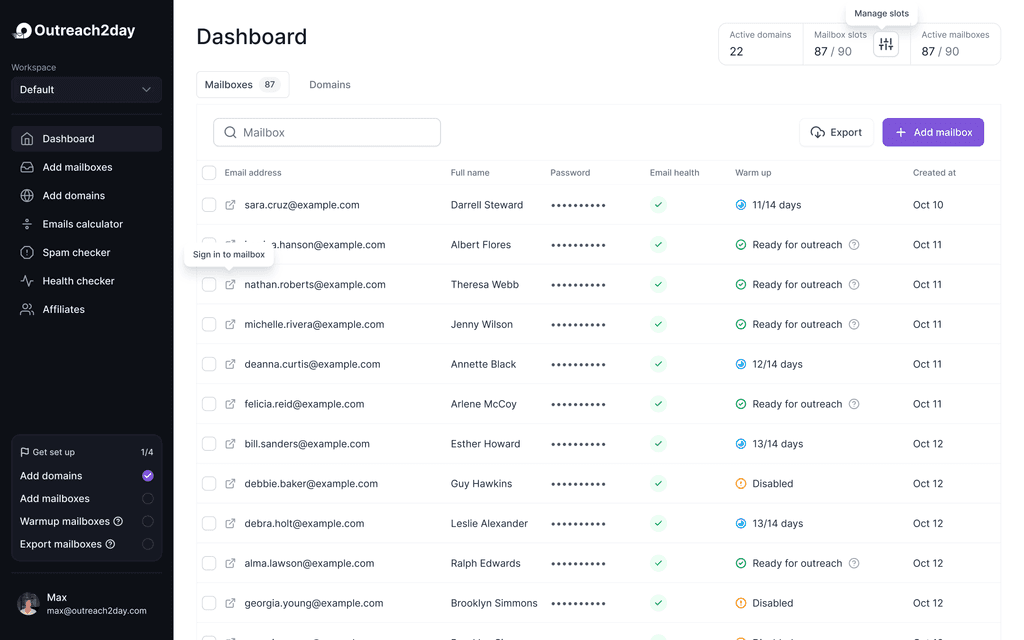

See deliverability issues before they kill performance
Monitor mailbox health in real time, spot degradation early, and keep warmup, protection, and sending in one place.