On this page
Short answer
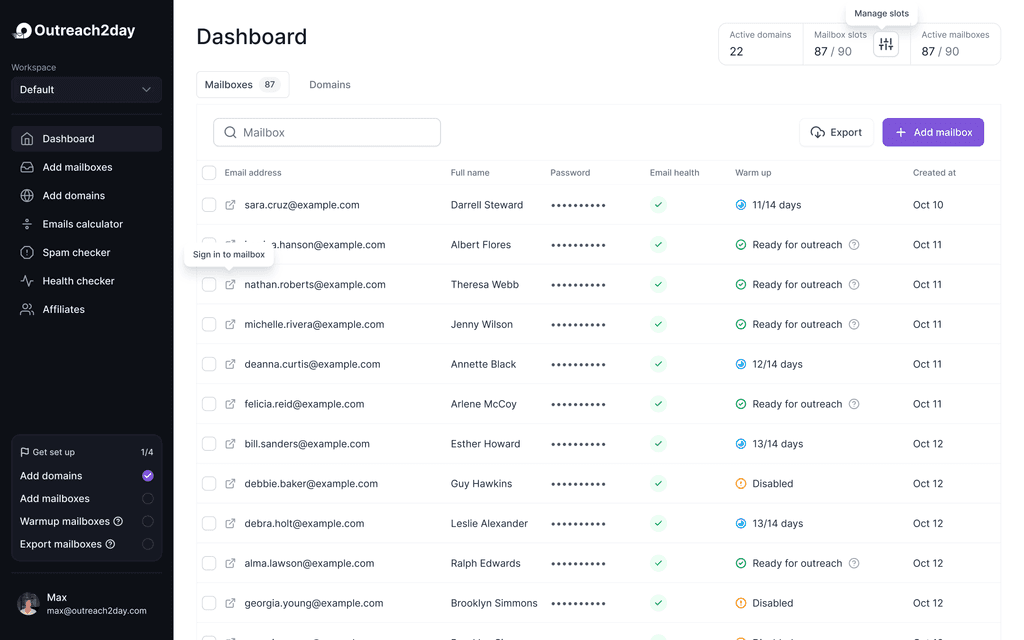
Warm up a new mailbox for at least 14 days before it sends any cold email. From day 14, start cold email at a low volume and raise it gradually to full volume around day 21. Cheaper domains such as .info can need a couple of extra weeks. Keep warm-up running after you start sending.
The timeline
Day | What happens |
|---|---|
0 | Domain and mailboxes set up. On your own domains, allow 24 to 48 hours for the nameserver change |
1 to 14 | Warm-up only, no cold email |
14 | Start cold email at a low volume |
14 to 21 | Raise cold volume gradually |
Around 21 | Full volume: up to 25 cold emails per mailbox a day |
After 21 | Keep warm-up running alongside cold email |
For a .info or another cheaper extension, add a couple of weeks before full volume. See .info vs .com.
Why at least two weeks
A new mailbox on a new domain has no sending history. Warm-up builds one: the mailbox exchanges emails with a network of other mailboxes that open them, reply and move them out of spam. Warm-up is required, and a large part of the result depends on it. Mailboxes that skip it and go straight to full cold volume do worse, and they drag down the results of the rest of your setup when mixed in.
Google's sender guidelines describe the same principle for any new sender: "Start with a low sending volume to engaged users, and slowly increase the volume over time," and "Avoid introducing sudden volume spikes if you do not have a history of sending large volumes."
What slows warm-up down
Warm-up that isn't running. "Connected" in a sending tool doesn't mean warm-up is on. Check that warm-up emails are being sent and received.
DNS not ready. If SPF, DKIM or DMARC haven't propagated when warm-up starts, it can fail quietly. New records can take up to about two days.
Cheap extensions. .info and similar domains tend to need a couple of weeks longer.
Abrupt changes. Jumps in warm-up or cold volume set you back. Change volume in steps.
Is day 14 always enough?
It's the minimum, not a guarantee. Before you raise cold volume, check:
Warm-up inbox rate is stable across several days and not falling. See warm-up inbox rate dropped.
SPF, DKIM and DMARC pass on a test message.
A placement test with a neutral email lands in the inbox for both Google and Outlook recipients.
If any of these fail, keep warming and hold cold volume.
What warm-up does not do
A high warm-up score does not prove cold placement. Warm-up partners have a history with your mailbox; your prospects don't. Use the warm-up score as an early warning, and use placement tests and replies to judge cold email. See placement tests.
Plan ahead
Every new mailbox needs the full warm-up, including the ones you add to replace a burned domain. If you plan to scale or rotate domains, create and warm the extra mailboxes three weeks before you need them.
What we recommend at Outreach2day
Warm-up only for at least 14 days, low cold volume from day 14, full volume around day 21, and warm-up kept running while you send. New mailboxes are ready within 24 hours, and warm-up is included for as long as you keep the mailbox.
Sources
- Google: Email sender guidelines: support.google.com/a/answer/81126
Related answers
- Should I Keep Warm-Up Running While Sending Cold Email?Warm-up
- How Many Cold Emails Should One Mailbox Send per Day?Volume and setup
- Is .info or .com Better for Cold Email Domains?Domains
- My Warm-Up Inbox Rate Dropped. What Does It Mean?Warm-up