On this page
Short answer
A drop in warm-up inbox rate is an early warning that providers trust the mailbox, its domain or its sending IPs less. It is not a measure of where your cold emails land. Check that warm-up is actually running, see which providers dropped and whether one domain or all of them did, look at recent volume changes, and hold cold volume until a placement test confirms the cause.
What it means
Warm-up sends emails between your mailbox and a network of other mailboxes that open them, reply and move them out of spam. The warm-up inbox rate shows how often those emails reached the inbox.
Read it with two limits in mind:
It is not cold placement. Warm-up partners have a history with your mailbox. A cold recipient has none, so a high warm-up rate does not prove your cold emails reach the inbox.
A drop is still a real signal. When warm-up emails start landing in spam, the provider trusts the mailbox, its domain or its sending IPs less. A high warm-up spam rate is one of the more reliable bad signs you can get.
Check this first
Is warm-up actually running? "Connected" in a sending tool only means it can log in. Warm-up can be stopped, disabled after an import, or never started because DNS had not propagated when it was turned on. Confirm that warm-up emails are being sent and received.
Is it one day or a trend? One bad day is noise. Look at several days before acting.
Which provider dropped? If only Google recipients dropped and Outlook held on the same mailboxes, the cause is on the provider side or in how that provider rates your sending IPs, not in the individual mailboxes.
One domain or all of them? If one domain dropped while other domains on the same sending IPs are fine, the domain is the problem. If every domain on the same IPs dropped, it is the IPs.
What changed in the last few days? A jump in cold volume, new mailboxes added without warm-up, or a sudden change in warm-up volume often comes right before a drop. Google's sender guidelines warn that "immediately doubling previously sent volumes suddenly could result in rate limiting or reputation drops."
Did the domain expire or get listed? An expired domain stops its mailboxes. A blocklist listing is worth checking, though a listing alone does not prove it caused the drop.
What to do
Hold cold volume on the affected mailboxes. Don't raise it until you know the cause.
Keep warm-up running and steady. Don't push warm-up volume up sharply to "fix" the rate; abrupt jumps in any volume, including warm-up, make placement worse.
Run a placement test with a neutral control email next to your campaign email, from the same mailboxes, in the same minute. See how to read placement tests.
Act on the layer that failed.
One domain: rest it, try a fresh campaign on it, or replace it. See burned domain.
All domains on the same IPs: the sending IPs need attention. On managed mailboxes, contact your provider.
Only the campaign email fails: the copy is the problem, not the mailbox.
Resume gradually once the rate recovers.
If you also send to personal Gmail accounts, Postmaster Tools can show your spam rate and delivery errors. Google notes its dashboard data "isn't real-time data" and is typically updated within 24 hours, sometimes later.
What we recommend at Outreach2day
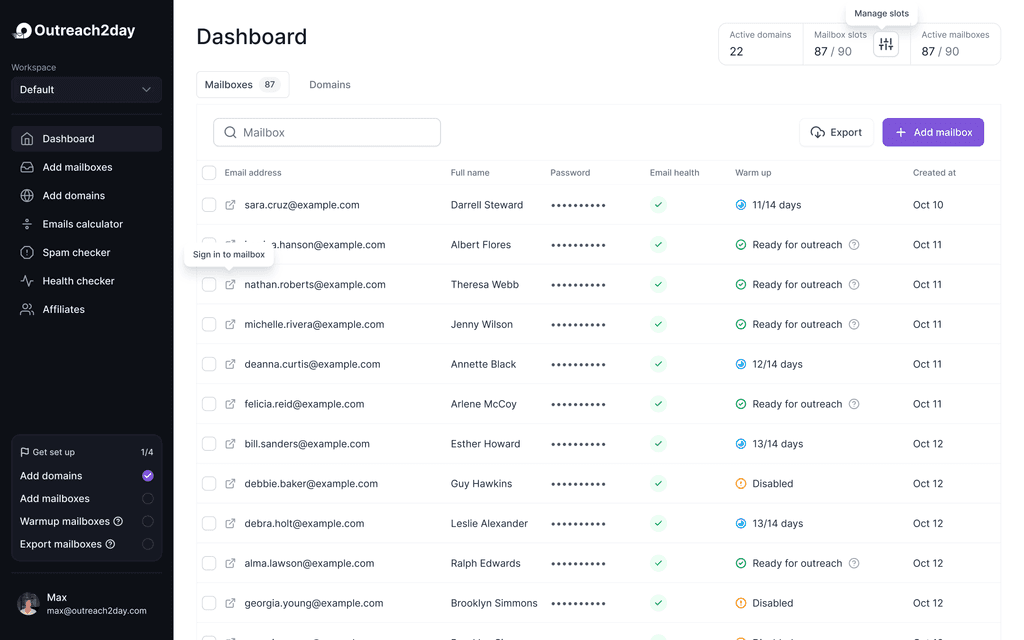
Warm-up is required, and we recommend keeping it running for as long as the mailbox sends cold email. Each mailbox shows its warm-up inbox, spam and bounce rate, so you can see which mailboxes and domains dropped and act on those only.
Sources
- Google: Email sender guidelines: support.google.com/a/answer/81126
- Gmail Help: Postmaster Tools dashboards: support.google.com/mail/answer/14668346
Related answers
- Should I Keep Warm-Up Running While Sending Cold Email?Warm-up
- How Long Should I Warm Up a New Mailbox Before Cold Email?Warm-up
- Are Inbox Placement Tests Reliable for Cold Email?Warm-up
- My Cold Email Domain Is Burned. What Should I Do?Domains