On this page
Short answer
Yes. Keep warm-up running for as long as the mailbox sends cold email. It keeps a steady flow of emails that are opened and replied to alongside your cold volume, and its inbox and spam rate warn you early when a mailbox or domain starts to slip. Keep warm-up volume steady and change it in small steps, never in jumps.
Why keep it on
Warm-up doesn't end when cold email starts. Two reasons to keep it running:
It balances your traffic. Cold email gets few opens and replies. Warm-up adds a steady stream of emails that are opened, replied to and rescued from spam, from the same mailbox, every day.
It is your early warning. The warm-up inbox and spam rate move before replies do. A mailbox or domain whose warm-up emails start landing in spam is losing trust with the provider, and you see it within days.
Stopping warm-up after the first two weeks removes both. The mailbox then sends only cold email, with no signal until replies fall.
Keep it steady
Google's sender guidelines ask senders to "Send email at a consistent rate. Avoid sending email in bursts," and warn that "immediately doubling previously sent volumes suddenly could result in rate limiting or reputation drops." That applies to warm-up too:
Keep warm-up volume at a stable daily level.
If you change it, change it in small steps over several days.
Don't raise warm-up sharply to "rescue" a mailbox. Abrupt jumps in warm-up volume make placement worse, not better.
Keep the default warm-up topic rather than switching warm-up content to match your offer.
What warm-up metrics tell you, and what they don't
Signal | What it means |
|---|---|
Warm-up inbox rate stable | No early warning. It does not prove cold placement |
Warm-up spam rate rising | The provider trusts the mailbox, domain or sending IPs less. Act on it |
Warm-up rate falls on one domain only | That domain is the likely problem |
Warm-up rate falls on all domains on the same IPs | The sending IPs are the likely problem |
A high warm-up score does not prove your cold emails land in the inbox. Warm-up partners have a history with your mailbox; your prospects don't. Use placement tests and replies to judge cold email. See placement tests.
Check that it is actually running
"Connected" in a sending tool only means the tool can log in. Warm-up can be stopped, disabled after an import, or never started because DNS wasn't ready. Confirm that warm-up emails are being sent and received for every mailbox, especially after moving mailboxes between tools.
Keep warm-up out of your real inbox
If warm-up emails show up where you read replies, check forwarding rules and warm-up filters. Forward cold-mailbox mail only to internal mailboxes, not to your main company inbox.
What we recommend at Outreach2day
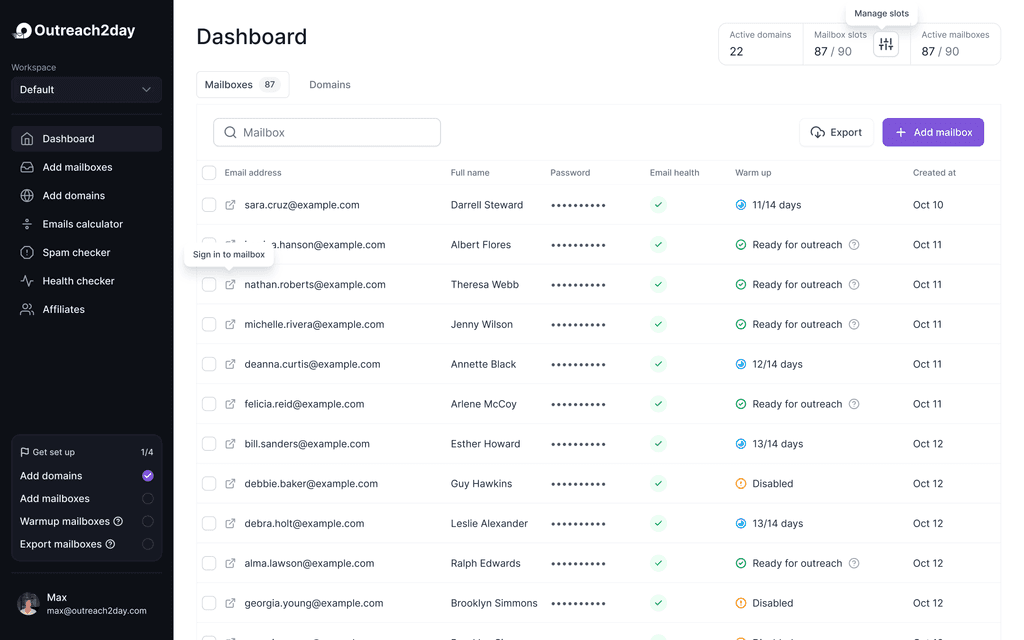
Warm-up is required. Warm up for at least 14 days before cold email, start low from day 14, reach full volume around day 21, and keep warm-up running while you send. Warm-up is included for as long as you keep the mailbox, and each mailbox shows its warm-up inbox, spam and bounce rate.
Sources
- Google: Email sender guidelines: support.google.com/a/answer/81126
Related answers
- How Long Should I Warm Up a New Mailbox Before Cold Email?Warm-up
- My Warm-Up Inbox Rate Dropped. What Does It Mean?Warm-up
- How Many Cold Emails Should One Mailbox Send per Day?Volume and setup
- Are Inbox Placement Tests Reliable for Cold Email?Warm-up